


Last year, I set the ridiculous goal of reading 100 pages per day for 2025. And I am happy to report that I met this goal with one small caveat. In June, when my father-in-law passed, I suspended the goal to spend more time with family. When I started back up in July, I revised the goal for weekdays only.
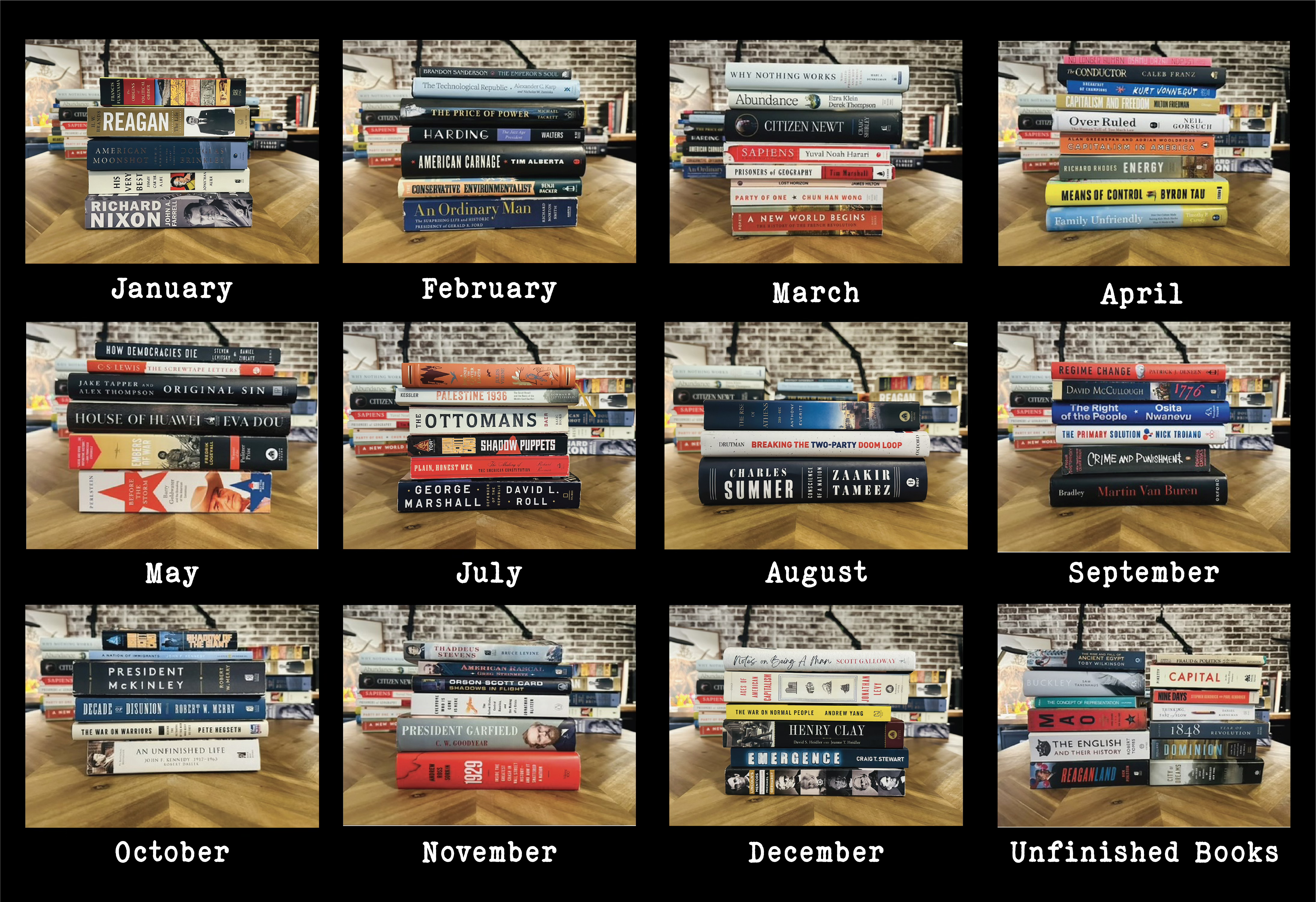
In 2025, I completed 70 books and read another 13 that I did not finish. In total, I read 27,980 pages, averaging 107 per day. I also read the bible nearly every day, although I did not count that in my figures. I didn’t read the entire Bible this year, but I did read the entire New Testament. Scroll to the end to see my full reading list for 2025.
I set this goal for various reasons. One of those reasons was that, after reading so much for such a short period of time over the last few years, I found myself struggling to find motivation to read. In my endeavor with No Cap Fund, education is a priority for me. Understanding the nuances of the American political system and policy is something that I need to maintain focus on. And I knew that if I set a goal, I’d be more motivated to keep going.
I also wanted to start representation chapters, or, as they’ve evolved into, town halls, where I represent my local community, gather people together, and talk about a specific policy issue. And I wasn’t prepared to do that last year, and I wanted to be prepared by 2026 for the midterms. First meeting is January 27th, 2026. If you want to learn more about this and RSVP, check out the community events page on www.why435.org.
So, I set a goal, and I was intentional about what I read. I continued my reading of American political history, moving up through the timeline, the 60s, 70s, and into the 80s. I dove deeper into the dark ages of American politics, the Antebellum period, and the Gilded Age. I also focused on economics because, as James Carville famously said, “It’s the economy, stupid.” I expanded into world history this year, as well as energy, tech, and China. I studied the ideas of modern thinkers on political reform and dove into one of the most contentious policy issues of the day: immigration.
So, as the year comes to a close and a new year begins, I figured I’d give you a little review of what I learned, some of my favorites, and least favorites of 2025.
American Politics: 60s, 70s, and 80s.
After reading about Kennedy, LBJ, Nixon, Korea, and Vietnam, it seems to me that America began to lose its way after World War II. The politics of LBJ and the leadership style of Nixon had a corrosive effect on the country. In its fear of communism, America too often confused nationalism with ideological subversion, leading to interventions that ultimately did more harm than good. That does not mean America is the villain of history only that, like any nation, it is imperfect. We shouldn’t shy away from our mistakes; we should study and learn from them. And for all their faults, leaders like LBJ and Nixon were acting on what they believed to be the best information available at the time. They were more cutthroat and morally ambiguous than others, but they were also trying, in their own ways, to do good and they did achieve some genuine accomplishments along the way.
The Economy
What I learned this year is that James Carville is right; it is all about the economy. People care about their livelihood, their ability to raise their family, pay their bills, and pursue happiness. Whether that be buying a new car, going on vacation, or just setting up their family for future success, it’s impossible to read any type of American political history without reading about economics.
But I dove into economics as a whole this year, reading Capitalism in America, Capital in the 21st Century, Capitalism and Freedom, 1929, and Ages of American Capitalism, among others. What I learned is that the economy is both simple and complicated, but I will have more on that in a later Substack.
Dark Ages of American Politics
In my reading of the dark ages of American politics, specifically the antebellum period, I realized how dangerously close we are to coming unraveled as a nation. There are stunning similarities between the dysfunction that led to the Civil War and the dysfunction we are experiencing right now.
Specifically, an imbalance of representation, politicians gerrymandering for power, the inability to elect a speaker in the House, and the rise of political violence. We saw the rise of violence in both the Antebellum period and the Gilded Age, and again in the 60s. It happens when people feel unrepresented, and their rights are being ignored. Leaders stoke divisions, and society’s loners act on their worst impulses. With the assassination attempts on President Trump and the assassination of Charlie Kirk, we are seeing it again today.
We must realize that we are all on the same team. We have to stop pointing fingers at each other and come together around a common cause. And that common cause in American history has been self-government, the ability to represent ourselves through elected representatives who represent our interests.
That’s why at No Cap Fund, we encourage people to unite for representation. We want to channel people’s frustration into something constructive and positive. Representation gives people a voice, an opportunity to use their words and their ballot to make change, so they don’t have to resort to violence.
World History
In world history, I read about the French Revolution, the British Empire, the Vietnam War, the Ottoman Empire, Palestine, Egypt, and Athens. And what I learned is that everyone wants power and agency over their own lives. When it comes to government, that power and that agency is found in representation. Whether it be the English Civil War, the French Revolution, or the American Revolution, they were all battles for more representation.
Even the Vietnam War began, at its core, as a fight for self-government. After World War I, Ho Chi Minh went to the 1919 Paris Peace Conference, hoping to appeal to President Woodrow Wilson’s promise of national self-determination. He asked for a representative government and basic political rights for the Vietnamese people. He was ignored.
That rejection helped push Vietnam down a darker path. What began as a nationalist demand for representation became a violent struggle against French colonial rule, and later a civil and ideological war that pulled in the United States. In the end, it was a tragedy rooted in the failure to take self-government seriously when it was first peacefully requested.
Immigration
Reading about immigration, I’ve come to appreciate how important immigrants have been to the success of the American Republic. At the same time, history shows how bad political actors can exploit immigration. In the late nineteenth century, figures like Boss Tweed used immigrant communities as political pawns—trading favors, protection, and patronage for votes to entrench their power.
That danger has not disappeared. Today, political incentives still exist to treat immigration as a tool for power. Some elected officials have openly admitted they want to bring in more immigrants to their district “just for redistricting purposes,” so they can keep their seat. At the same time, recent controversies and investigations in places like Minnesota have raised concerns about corruption, mismanagement, or abuse connected to immigration-related programs. These patterns undermine public trust and weaken support for reform.
Politicians should support immigration because it strengthens America, not because it helps them hold office. They should pursue serious, honest reform: securing the system, keeping bad actors out, and providing a clear, lawful pathway to citizenship for those who want to contribute and meet the requirements.
Everyone deserves representation in the government where they live. And that means a proper representation ratio. The principle of representation has been fought for time and time again throughout history. If America truly believes in self-government, then we must defend that right.
Political Reform
In my reading on political philosophy this year, I realized how we’re not really as divided as our political leaders would have us think. Those in academia have different ideas, but at the core, they all agree that self-government rests on representation. Left, right, and center all agree we need to uncap the house. Americans deserve representation.
Energy, Tech, and China
While reading about energy, technology, and China, I came to better understand how central energy is to economic growth and human prosperity, and how critical technological leadership will be to the future. The United States and China are now engaged in a long-term competition for global influence and technological leadership. We do not have to be hostile toward China, but we also should not ignore the reality of that competition.
Meeting this moment requires confidence rather than fear. We should be investing in clean, abundant sources of energy that expand prosperity and strengthen national resilience. And rather than shying away from new technologies, we should seek to understand and master them before they master us.
Favorite Biography of 2025
My favorite biography I read this year was An Unfinished Life by Robert Dallek about John F. Kennedy. I loved this book because John F. Kennedy is a very complex and interesting figure. His story is one of virtue and vice, and there is much to be learned from it. He was president at an incredibly tense time in American history. Kennedy was born to be a leader in a family of wealth and privilege. He saw it as his duty to sacrifice for his country. Although he was riddled with debilitating conditions that left him in constant pain, he still served during WWII. His brother was killed, and he nearly lost his life rescuing fellow service members after their PT boats were attacked.
His handling of the Cuban Missile Crisis was masterful, and few leaders could have navigated such immense pressure without catastrophe. Surrounded by military, political, and international forces pushing toward escalation, he chose restraint over impulse. The weight of the world rested on his shoulders, yet it did not crush him. Instead, he eased it down through patience, diplomacy, and a belief that even adversaries could be reasoned with, choosing peace over pride, and judgment over force.
Runner-up
The runner-up for favorite biography was President Garfield: From Radical to Unifier by CW Goodyear. The Netflix show Death by Lightning took history nerds like me by storm this year. The show is based on Candace Millard’s book Destiny of the Republic about Garfield’s assassination, which I read a few years ago. Goodyear’s biography was a lot more detailed, and it gave me a fuller understanding of who James Garfield was.
He was somebody who came to political power through a very contentious time in American politics. He served in the Civil War, in the House of Representatives, and eventually became president during a period of grand corruption. His focus was cleansing his party and American politics of that corruption, and it ultimately cost him his life. But his legacy lived on. His death was not in vain, and reform did set in.
Hardest book of 2025
The hardest book I read this year was Capital in the Twenty-First Century. It was so hard, in fact, that I didn’t even finish it. I put it down for another time. It’s written by French economist Thomas Piketty, and I found myself overwhelmed at times while reading the book. I decided I needed a bit more background before continuing.
Runner up
The second-hardest book I read this year was Ages of American Capitalism. It was a different kind of hard. It was challenging to read because it was so dense, covered so much information, and was very long. I did enjoy it through. I definitely understand economics more in a practical sense than in a theoretical one. Reading about how it affects individuals day to day and how politics shift definitely helped me better understand what I had read about Capital in the Twenty-First Century. In fact, it helped so much that, as I mentioned, I have a Substack coming soon about it. I will be going back to Capital in the Twenty-First Century in 2026.
Favorite nonfiction book of 2025
My favorite nonfiction book of the year was Embers of War: The Fall of an Empire and the Making of America's Vietnam by Fredrik Logevall, which explores the origins of the Vietnam War. The book does an excellent job dissecting the complex and often competing factions involved, including Vietnamese nationalist and communist movements, the French colonial regime in Indochina, and, eventually, the growing role of the United States. It offers clear explanations for why the conflict emerged and how it escalated, along with vivid accounts of key battles and detailed insight into how decisions were made both on the ground and behind closed doors for political and strategic reasons.
Runner-up
My runner-up for favorite nonfiction book of the year was 1929 by Andrew Ross Sorkin. This was a story about the stock market crash of 1929. It was enlightening and educational, helping me understand what makes the market run and what brings it down. To put it simply, the market runs on confidence, and it’s brought down by over-speculation. Sorkin does a great job telling the story of the market crash and the people involved in it and in its aftermath.
Favorite fiction book of 2025
My favorite fiction book of the year was Shadow of the Giant by Orson Scott Card. For those of you who follow me over on Written Works and listen to the What the Book podcast, know that I love Orson Scott Card, and Shadow of the Giant was kind of the finale of the Shadow series. It was amazing! It was a very emotional read for me, because I had to say goodbye to a bunch of characters whom I’d come to know over the course of the series.
OSC always does a great job with his geopolitics, factions, power, virtue, and vice. Shadow the Giant was no different. I highly recommend that you pick it up and read it. In fact, read the whole Shadow series.
Runner up
My runner-up for the year was Jules Verne's Journey to the Center of the Earth. My dad actually bought me this book when I was a kid, but it was the children’s version, and I had never actually read the full adult version. I have to admit, the first hundred pages had me a little bored. But after that, the book was amazing. The detail in which Vern writes as the characters explore the center of the earth really paints a beautiful picture in your mind as you’re reading. It’s thoughtful and incredibly interesting.
Least favorite book of 2025
My least favorite read I had all year was Nine Days: The Race to Save Martin Luther King Jr.’s Life by Stephen Kendrick and Paul Kendrick. It’s not that the story isn’t valuable. It’s that the book is written in a dry, mundane, and politically biased way. It doesn’t tell the story as much as it lectures you. I didn’t enjoy it or finish it. I put it down, and maybe I’ll come back to it in 2026. Martin Luther King is one of the people I want to read about in the new year, and after reading his biography, I might come back to this book with a different perspective.
Runner up
The runner-up for Worst Book of the Year for me was Crime and Punishment by Fyodor Dostoevsky. This was another book that I read for the What the Book podcast. I’ve always wanted to read this, and I regretted it. For me, it was difficult to keep track of the characters, as they all had Russian names that were very similar. I didn’t like the main character; he was an axe murderer and constantly rationalizing his bad behavior. The characters often just droned on and on and on about their misery. It wasn’t very suspenseful, and it was full of dialogue. It was a slog to get through.
Overall favorite book of 2025
And finally, my favorite book I read in 2025 was The Conductor by Caleb Franz. I loved this book for many reasons. First, it tells the story of a largely overlooked figure from the antebellum period who helped enslaved people escape to freedom. Before reading it, I had never heard of John Rankin, yet his life and convictions were deeply inspiring. Rankin helped lay part of the moral foundation of the abolitionist movement through both his actions and his writing.
The story isn’t only about escape and resistance; it’s also a story about family, about the break between Rankin and his brother over slavery, and about the love, trust, and shared purpose between Rankin and his sons. I’m a sucker for books that tell a strong family story, and The Conductor tells one that needed to be told. I highly recommend it. Go pick up a copy!
Final Reflection
As I look at the books I read this year and compare them to the op-eds I wrote, I notice that many of the op-eds were directly fed by what I read. (Check out my latest op-ed No, AI won’t ruin your life — it might even give you a four-day work week out today in The Hill.) And if I had to give any piece of advice for any young person out there looking to wield political power, looking to get published and have their voice heard, it’s to read. It feeds your soul. It feeds your mind. It gives you the words to express yourself and the power to defend your rights. Like Fredrick Douglas said, “Once you learn to read, you will be forever free.”
Peace & Love,
Jeff Mayhugh
Check out my full reading list for 2025 below.
His Very Best: Jimmy Carter, a Life — Jonathan Alter
Richard Nixon: The Life — John A. Farrell
American Moonshot: John F. Kennedy and the Great Space Race — Douglas Brinkley
Reagan: A Life — H. W. Brands
Anthem — Ayn Rand
The Origins of Political Order — Francis Fukuyama
Nine Days: The Race to Save Martin Luther King Jr.’s Life — Stephen Kendrick and Paul Kendrick
Capital in the Twenty-First Century — Thomas Piketty
An Ordinary Man — Richard Norton Smith
The Conservative Environmentalist — Benji Backer
American Carnage — Tim Alberta
The Jazz Age President — Ryan S. Walters
The Emperor’s Soul — Brandon Sanderson
The Price of Power — Michael Tackett
Party of One: The Rise of Xi Jinping and China’s Superpower Future — Chun Han Wong
The Technological Republic — Alexander C. Karp & Nicholas W. Zamiska
A New World Begins: The History of the French Revolution — Jeremy D. Popkin
The English and Their History — Robert Tombs
Lost Horizon — James Hilton
Prisoners of Geography — Tim Marshall
Sapiens: A Brief History of Humankind — Yuval Noah Harari
Citizen Newt — Craig Shirley
Abundance — Ezra Klein & Derek Thompson
Why Nothing Works: Who Killed Progress—and How to Bring It Back — Marc J. Dunkelman
Reaganland: America’s Right Turn, 1976–1980 — Rick Perlstein
Family Unfriendly — Timothy P. Carney
Means of Control — Byron Tau
Energy: A Human History — Richard Rhodes
Capitalism in America — Alan Greenspan & Adrian Wooldridge
Overruled: The Human Toll of Too Much Law — Neil Gorsuch & Janie Nitze
Capitalism and Freedom — Milton Friedman
Breakfast of Champions — Kurt Vonnegut
The Conductor — Caleb Franz
No Longer Human — Osamu Dazai
Before the Storm: Barry Goldwater and the Unmaking of the American Consensus — Rick Perlstein
Embers of War: The Fall of an Empire and the Making of America’s Vietnam — Fredrik Logevall
George Marshall: Defender of the Republic — David L. Roll
Animal Farm — George Orwell
House of Huawei — Eva Dou
Original Sin — Jake Tapper & Alex Thompson
The Screwtape Letters — C. S. Lewis
How Democracies Die — Steven Levitsky & Daniel Ziblatt
Mao: The Unknown Story — Jung Chang & Jon Halliday
Journey to the Center of the Earth — Jules Verne
Plain, Honest Men: The Making of the American Constitution — Richard Beeman
Fraud & Politics at the turn of the century — Joseph L. Bristow
The Concept of Representation — Hanna Fenichel Pitkin
Shadow Puppets — Orson Scott Card
Buckley: The Life and the Revolution That Changed America — Sam Tanenhaus
The Ottomans: Khans, Caesars and Caliphs — Marc David Baer
Palestine 1936: The Great Revolt and the Roots of the Middle East Conflict — Oren Kessler
The Rise and Fall of Egypt — Toby Wilkinson
Charles Sumner: Conscience of a Nation — Zaakir Tameez
Thinking, Fast and Slow — Daniel Kahneman
Breaking the Two-Party Doom Loop — Lee Drutman
The Rise of Athens — Anthony Everitt
Crime and Punishment — Fyodor Dostoevsky
The Primary Solution — Nick Troiano
Martin Van Buren: America’s First Politician — James M. Bradley
The Right of the People: Democracy and the Case for a New American Founding — Osita Nwanevu
Regime Change: Toward a Postliberal Future — Patrick J. Deneen
1776 — David McCullough
City of Dreams: The 400-Year Epic History of Immigrant New York — Tyler Anbinder
President McKinley: Architect of the American Century — Robert W. Merry
An Unfinished Life: John F. Kennedy, 1917–1963 — Robert Dallek
The War on Warriors — Pete Hegseth
Shadow of the Giant — Orson Scott Card
Decade of Disunion — Robert W. Merry
A Nation of Immigrants — John F. Kennedy
Dominion: How the Christian Revolution Remade the World — Tom Holland
1929: Inside the Greatest Crash in Wall Street History--and How It Shattered a Nation — Andrew Ross Sorkin
The Ages of American Capitalism — Jonathan Levy
Everyone Who Is Gone Is Here — Jonathan Blitzer
Shadows in Flight — Orson Scott Card
President Garfield: From Radical to Unifier — C. W. Goodyear
Thaddeus Stevens: Civil War Revolutionary, Fighter for Racial Justice — Bruce Levine
American Rascal — Greg Steinmetz
Lincoln’s Mentors — Michael J. Gerhardt
Emergence — Craig T. Stewart
Henry Clay: The Essential American — David S. Heidler & Jeanne T. Heidler
War on Normal People — Andrew Yang
Notes on Being a Man — Scott Galloway
1848: Year of Revolution — Mike Rapport
You just did damage to my Amazon shopping cart lol